Organizations invest millions each year developing employee capability. But much of that investment never appears on a balance sheet, a transcript, or a promotion plan.
At IMPACT 2026, panel "Turning Experience into Credit" made the case that this is one of the more overlooked opportunities in workforce strategy today. Several organizations that attended the session are now asking how Credit for Prior Learning could fit within their existing learning and development strategies. Here's what the session revealed, and why it's worth paying attention to.

At a glance: Credit for Prior Learning (CPL) is the process by which colleges evaluate knowledge and skills employees have already gained outside a classroom, through leadership programs, employer training, military service, or hands-on experience, and convert it into academic credit. At IMPACT 2026, employers and academic partners made the case that CPL isn't an administrative footnote. It's a workforce strategy already available inside training most organizations already run. For employers, CPL usually begins with having existing workforce training evaluated by an academic partner, not by asking employees to individually petition for credit.
Learning happens everywhere, not just in classrooms
For generations, higher education has largely operated on one assumption: learning happens inside a classroom.
Today's workforce tells a different story. Managers build leadership skills by coaching teams through hard conversations, while frontline employees master technical systems through hands-on experience. Many organizations already invest heavily in internal leadership academies, certifications, and role-specific training to support this growth. None of that learning disappears simply because it didn't happen on a college campus.
Joanne Jordan, Department Chair for Allied Health Care at Franklin University, put it simply: "Honoring what people already know."
Honoring what people already know.
- Joanne Jordan
Department Chair for Allied Health Care at Franklin University
Katie Parrish, Executive Director of Strategic Initiatives and Partnerships at Indiana Tech, described it more precisely. Credit for Prior Learning, she said, is "the knowledge and skills a learner acquires outside of the traditional classroom," evaluated and given real academic value through college credit.
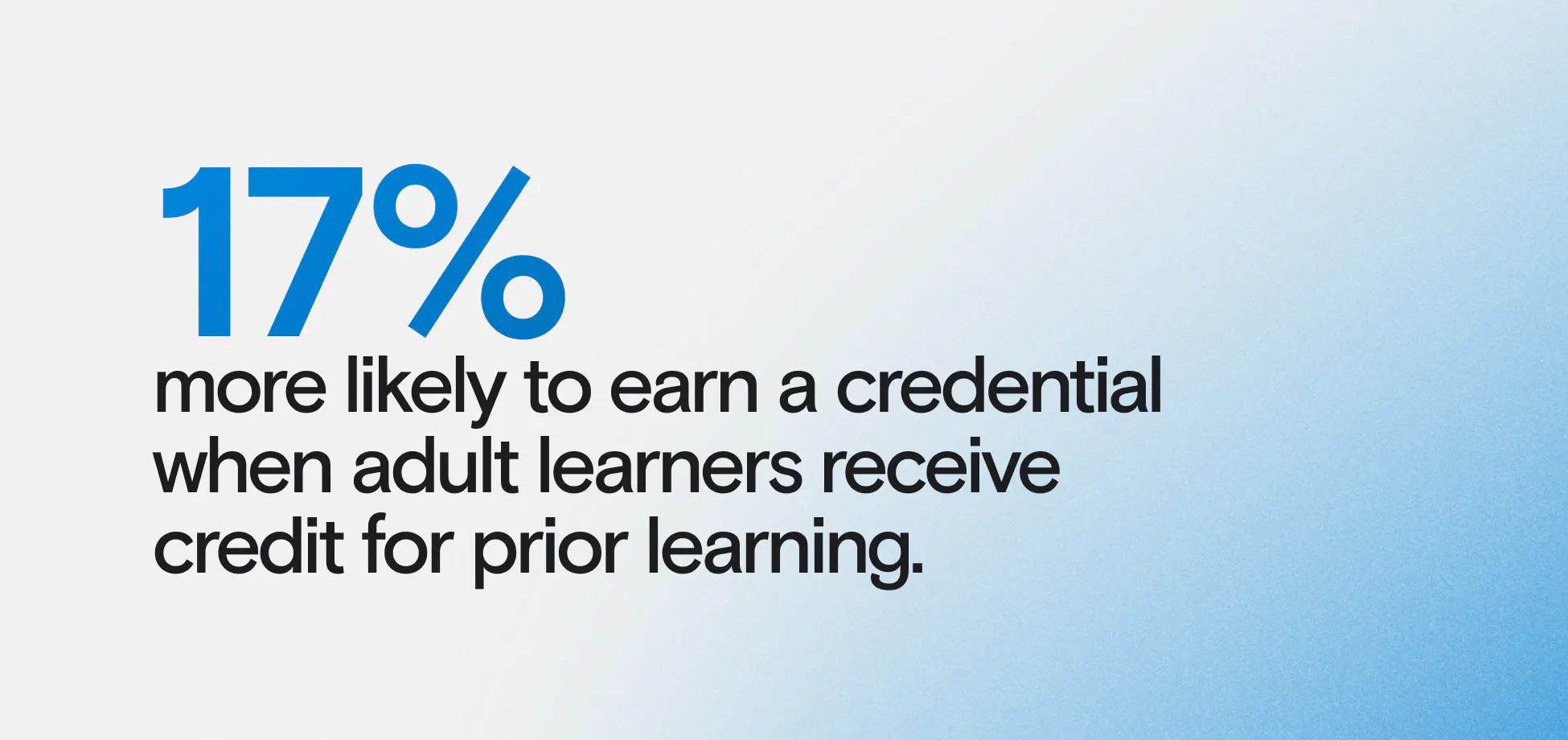
Research backs up why this matters. According to research from the Council for Adult and Experiential Learning (CAEL), adult learners who receive CPL are 17% more likely to earn a credential, and those who complete 12 or more CPL credits save an average of 9 to 14 months on their degree.
Forward-thinking employers are starting to ask a different question than the one higher education has asked for decades: how much knowledge already exists inside our workforce?
Your workforce already has valuable knowledge
Taco Bell's story was the clearest example from "Turning Experience into Credit."
Jamie Gonzalez, who works in team member engagement at Taco Bell, described a manager training pipeline, shift lead to assistant GM to GM, running for years with no academic recognition attached to it. The training itself was both challenging and transformative, equipping team members with the skills, confidence, and experience to grow into stronger leaders. Yet it did not count for anything outside the company.
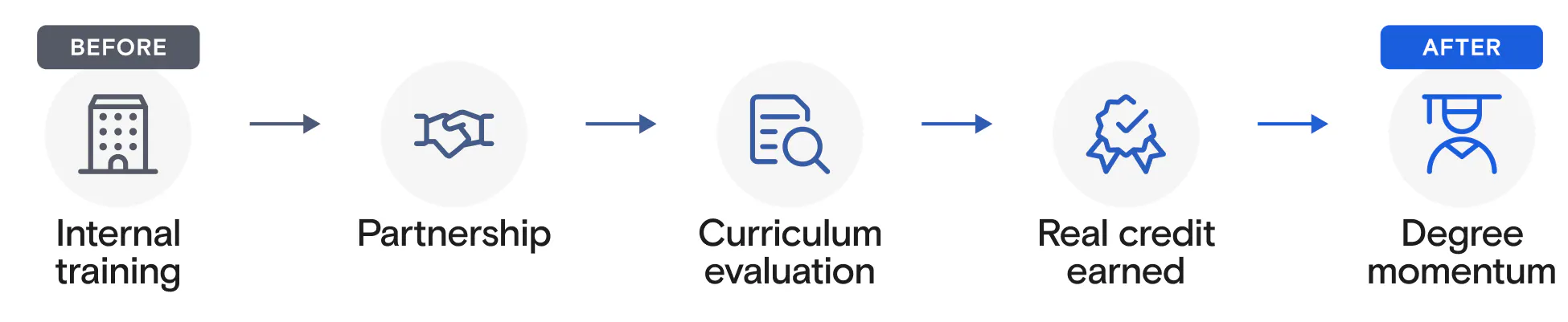
Working with academic partners, Taco Bell had that curriculum evaluated against college-level learning outcomes. The finding: employees were already demonstrating capabilities worth real academic credit.
That evaluation happened well before any employee submitted paperwork of their own. Faculty reviewed the manager training course by course, determined where it already met academic standards, and built a clear path for employees to follow.
Employees who complete Taco Bell's full manager training pipeline, shift lead through general manager, can earn up to 27 credits at Indiana Tech, up to 32 at Franklin University, or up to 9 at the University of Memphis Global. One employee, a team member in Bakersfield already exploring a degree at Indiana Tech, qualified for the maximum due to previously completed workplace training.
"They're already doing the hard work," Gonzalez said. The training already existed. What was missing was a bridge between that training and academic recognition.
For employers, that bridge begins earlier than most assume. Organizations don't ask employees to individually prove every skill they've learned. Instead, they collaborate with academic partners to evaluate existing leadership and workforce training programs, and when those programs demonstrate college-level learning outcomes, every employee who completes them benefits from the same pathway to credit.
Indiana Tech, Franklin University, and University of Memphis Global are part of a much larger group of InStride academic partners working with employers to evaluate workforce learning for potential academic credit. Across that network, institutions review leadership programs, technical training, and other employer-sponsored learning that may already meet college-level outcomes.
Together, Taco Bell and its academic partners changed how learning is recognized.
I thought getting started was going to be a long drawn-out process. And then it wasn’t.
- Jamie Gonzalez
People & Culture, Taco Bell
Gonzalez also described her own hesitation before starting: "I thought getting started was going to be a long drawn-out process. And then it wasn’t." In practice, the mechanism turned out to be simple: an employee completes the required training and sends proof of completion to the relevant academic partner's evaluation team, which functions like a transcript from another institution.
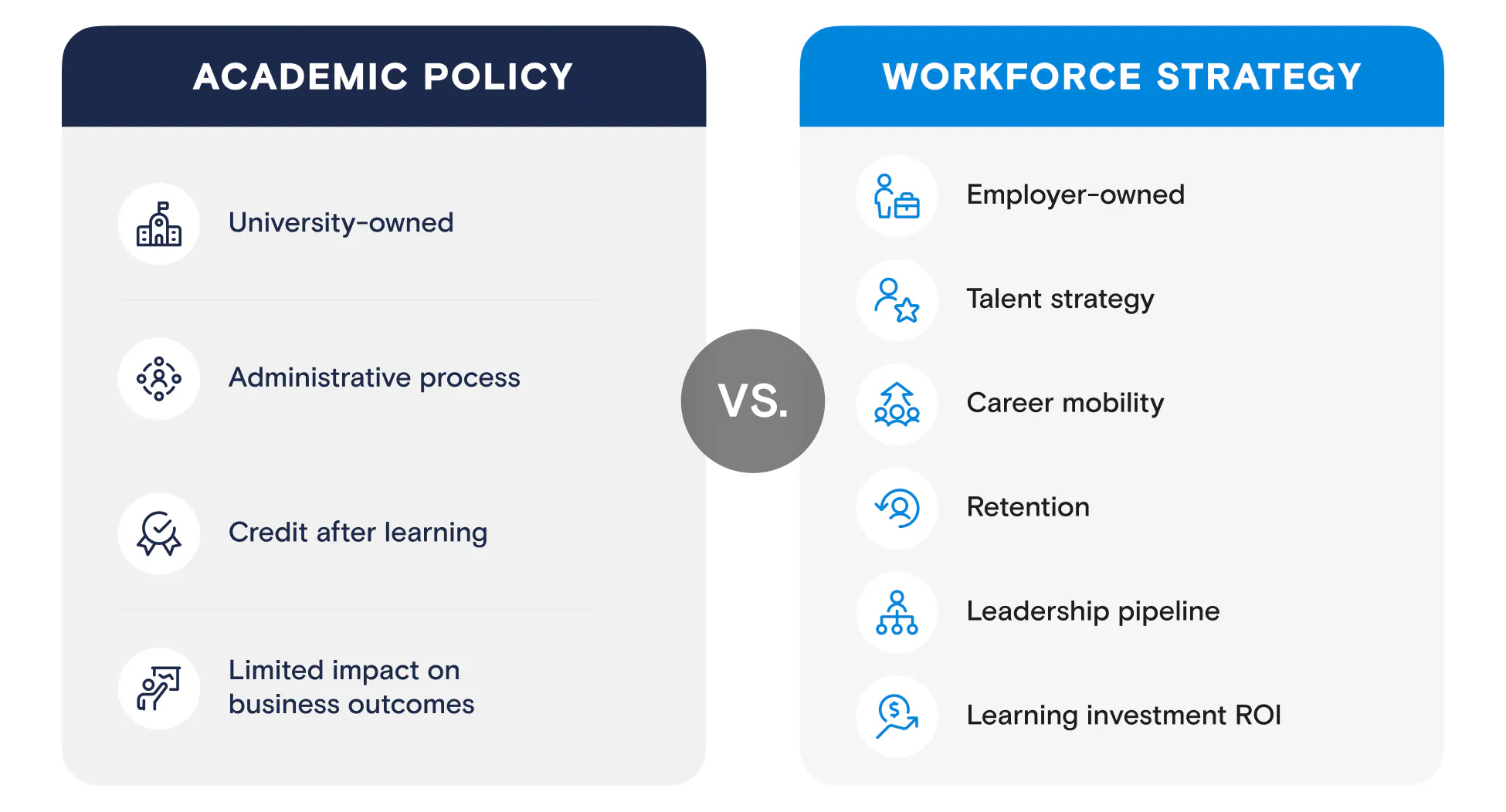
CPL is a workforce strategy, not an academic policy
Too often, Credit for Prior Learning gets filed under academic policy.
At IMPACT 2026, the organizations doing this well framed it as workforce strategy, not academic policy, and that reframing moved the conversation from the classroom to the boardroom.
Recognizing prior learning cuts the time and cost of finishing a degree, ensuring education is attainable for working adults to finish. It also gives employers something concrete: employees who build new skills, move into critical roles faster, and see a clearer line between the work they're already doing and the credential they're working toward.
Perhaps more importantly, it sends a message that has nothing to do with transcripts. Your experience matters. Your work has value. What you've already accomplished counts.
The organizations pulling ahead aren't asking employees to prove what they don't know. They're recognizing what they already do.
Design for credit from the start, don't retrofit it later
Credit for Prior Learning is about giving credit where credit is due.
The most forward-looking idea from the session was building new training differently from day one, designing it so credit is part of the plan from the start rather than something evaluated after the fact. Cohort-based, role-specific programs, developed jointly with employers and academic partners from day one, are increasingly built to make that recognition part of the design itself, not an afterthought.
Organizations across the country, similar to Taco Bell, work to bring academic partners into the conversation before designing new leadership programs, aligning learning outcomes with academic standards from the outset rather than sending materials for evaluation after the fact. Some begin by recognizing the value already embedded in training they already run. Others build new programs collaboratively from day one, so academic recognition is possible before the first course is even taught. Katie Parrish echoed this from the institution's side: the strongest partnerships start with a conversation about outcomes, not a pile of paperwork to review later.
Instead of asking "does this training happen to qualify," organizations get to ask "how do we build this so it obviously does," every time they run the program again.
Explore what's next
Leading organizations are rethinking employee education by recognizing existing employee capability alongside future learning. Discover how Capability Accelerators and other strategic education solutions help connect workplace learning, career mobility, and workforce strategy to build stronger organizations and greater opportunity for employees.
Many organizations are asking similar questions about workforce strategy, internal mobility, and how to prepare for what's next.
If you'd like to compare notes or learn how other organizations are approaching these challenges, let's continue the conversation.
A few questions we hear from workforce leaders
What is Credit for Prior Learning (CPL)?
CPL allows colleges and universities to evaluate knowledge and skills employees have gained through work experience, employer training, military service, certifications, or other learning outside the traditional classroom. When appropriate, that learning may count toward an academic credential.
Can workplace training really count toward a college degree?
In many cases, yes. Leadership development programs, technical certifications, management training, and other employer-sponsored learning may align with college-level learning outcomes when evaluated by academic partners, exactly what happened with Taco Bell's manager training pipeline.
Is Credit for Prior Learning just an academic process?
No. Increasingly, organizations are treating it as part of a broader workforce strategy that supports employee growth, internal mobility, and long-term workforce capability, not simply as a transcript review.